Blue Whales and Blue Skies 2025 Vessel Speed Reduction Season Results and Rankings
Shipping Industry Rises to Challenge of Larger Zones and Higher Award Thresholds
Share
Protecting Blue Whales and Blue Skies (BWBS) is proud to report the 2025 Vessel Speed Reduction (VSR) Season results from the efforts of participating shipping lines. Over the VSR Season, from May 1, 2025 to January 15, 2026, 787 participating vessels traveled over 481,000 nautical miles at whale-safer speeds of 10 knots or less. This is up from ~425,900 nautical miles and 743 participating vessels in the prior 2024 VSR Season.
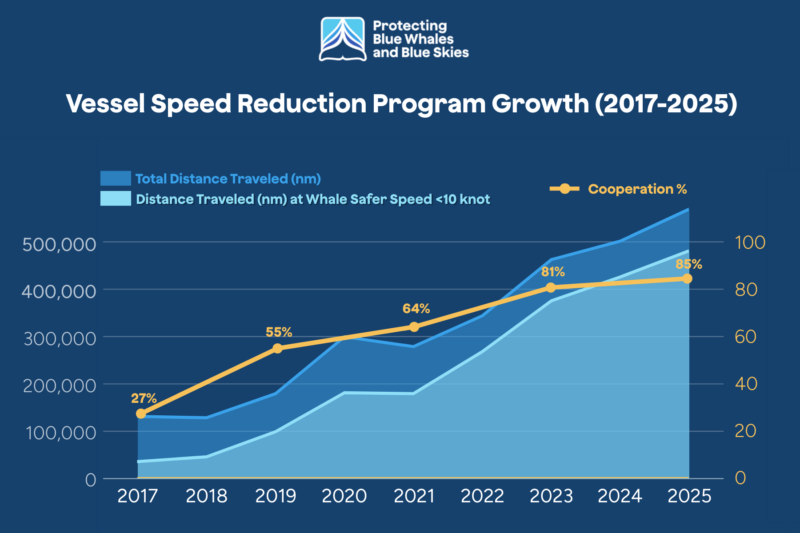
The VSR zones were expanded in 2025 to include Chumash Heritage National Marine Sanctuary (CHNMS), increasing the coverage of important whale habitat off California’s coast by ~2,600 square miles. To support greater conservation impact, the award category thresholds based on a fleet’s total distance traveled at 10 knots or less were also increased, Blue Sky (50-69%), Gold (70-89%) and Sapphire (90%+).
For each category below, awardees are listed in order by highest total fleet distance at whale-safer speeds.
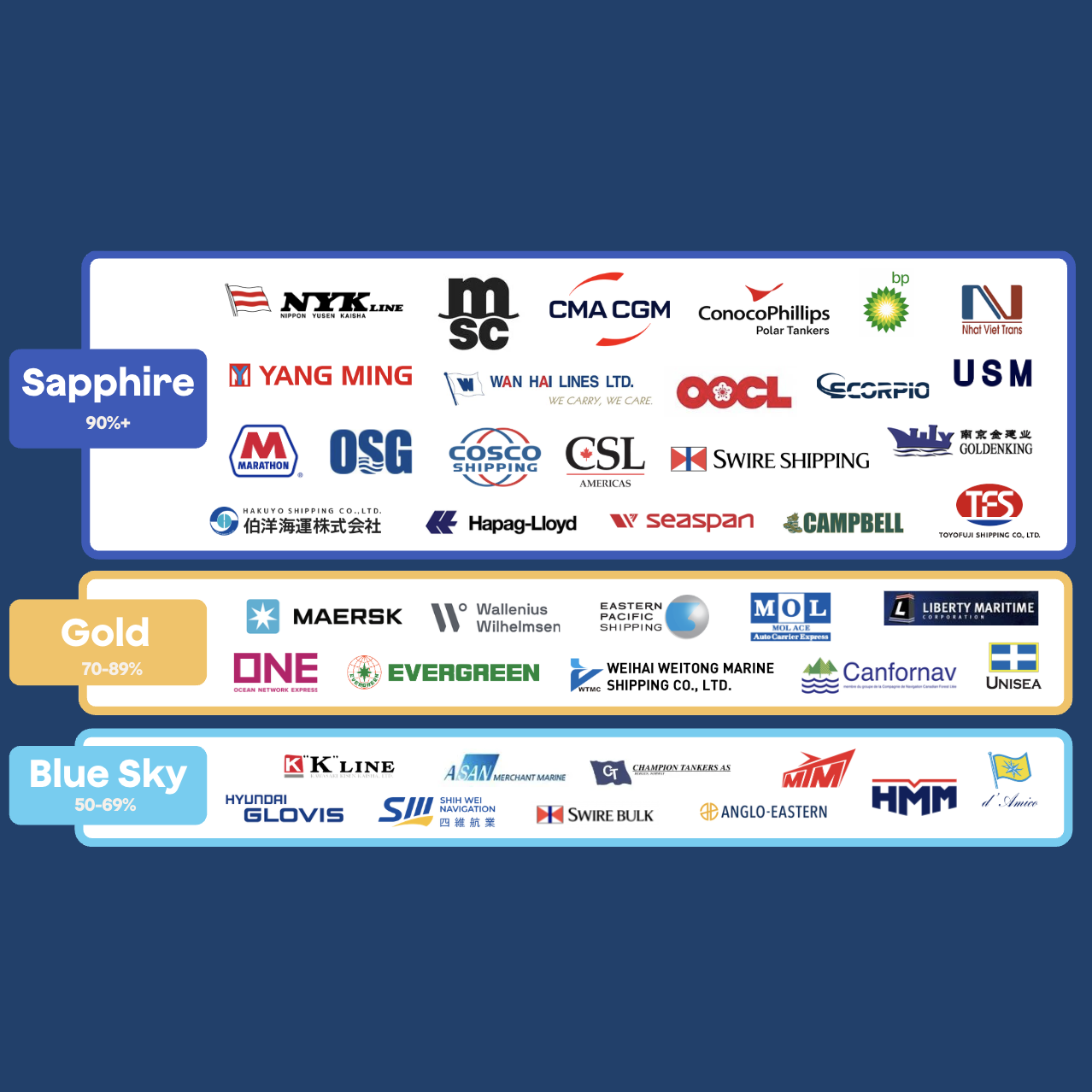
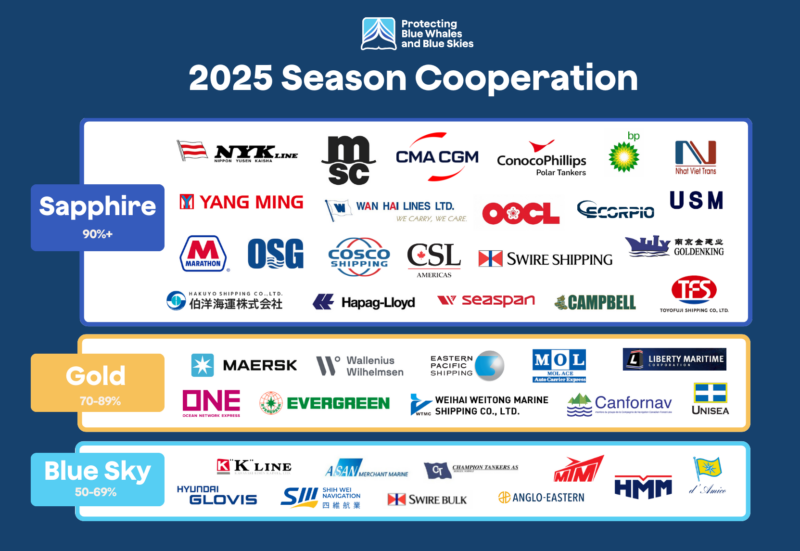
Top Sapphire Award Winners with 90%+ cooperation rate (up from 85% in 2024) include these twenty-two lines: CMA CGM; MSC; COSCO; NYK-RoRo; Yang Ming; OOCL; Hapag-Lloyd; Marathon Petroleum; OSG Ship Management; ConocoPhillips Polar Tankers; CSL Americas; Wan Hai Lines; Scorpio Group; Seaspan Corporation; Swire Shipping; BP Shipping Ltd.; Campbell Shipping Company; GoldenKing Ship Management Co.; Toyofuji Shipping Co.; Unity Ship Management; Hakuyo Kisen KK; and Nhat Viet Transportation Corporation.
Gold Award Winners with 70-89% cooperation rate (up from 60-84% in 2024) include these ten lines: Maersk; ONE; Evergreen; Mol ACE; Wallenius Wilhelmsen; Liberty Maritime; Eastern Pacific Shipping; Unisea Shipping Ltd; Canfornav; and Weihai Weitong Marine Shipping Co.
Blue Sky Award Winners with 50-69% cooperation rates (up from 35-59% in 2024) include these ten lines: Hyundai (UCC); K Line; Hyundai Glovis; D’Amico Group; Swire Bulk; Champion Tankers AS; Anglo-Eastern Shipmanagement; MT Maritime Management USA; Asan Merchant Marine Co. LTD; and Shih Wei Navigation.
BWBS also provides special recognition to program ambassadors that have demonstrated a high level of commitment to shipping with or working with participating shipping lines. Ambassadors play a critical role in growing awareness for responsible shipping and supporting the efforts of top performing lines. These companies are:
Sapphire Award (90%+ eligible shipments with participating lines): JAS Worldwide, Who Gives A Crap, Nomad Goods and Sonos.
Gold Award (70-89%): The Block Logistics, Port of Hueneme and Port of Oakland (port award level determined by percent of calls by participating lines)
BWBS is especially proud that two of our logistics and freight forwarder companies are ranked in our top award categories, and helping more companies find opportunities to ship whale-safer.
“Being recognized once again as a Sapphire Ambassador is both an honor and a responsibility we deeply value. BWBS continues to show that collaborative action can deliver real impact, protecting whales, reducing emissions, and helping raise our industries’ standards. We are proud to work alongside carriers and partners who share this commitment and continue advancing sustainable practices together,” said Andrea Goeman, SVP Global QHSE & Sustainability for JAS Worldwide.
“Meaningful change happens when good intentions meet practical action. Our role is to serve as a connector — supporting BWBS’ mission by translating its goals into real-world shipping decisions through data visibility, education, and transparent reporting that enable growing importers to participate meaningfully,” said Sami Romano, Sales Enablement & Marketing Manager for The Block Logistics.
Whale Protection and Air Quality
Two distinct but well-aligned issues are at the heart of BWBS: protecting coastal air quality and endangered whales. First, ship strikes are one of the top threats to whales globally and are of greatest concern in whale hot spots that overlap with major international shipping and cruise routes — as is the case for California’s coastal waters. Ships transit at whale-safer speeds of 10 knots or less, reduce the risk of fatal ship strikes by as much as 50%. Ocean noise from ships is also reduced. Second, air pollution is a major issue for California – with its onshore winds, unique geography and climate, and density of mobile source emissions. Notably, ocean-going vessels account for as much as 50% of some coastal counties’ air pollution. Ships transiting at 10 knots or less, can reduce air pollution by ~30%. For these reasons, BWBS has worked for over a decade to engage and support voluntary industry action on VSR requests by verifying cooperation, analyzing the environmental benefits, and celebrating industry cooperation and leadership. Efforts by industry to achieve high cooperation rates with VSR is no small feat, which is why they will be celebrated in an upcoming BWBS award ceremony.
How does BWBS verify shipping lines’ efforts?
BWBS determines which lines are eligible for awards by calculating the percent of the distance traveled by vessels at 10 knots or less out of their total fleet distance within the VSR zones. This is done by converting every raw data point from each vessel’s AIS stream into polyline segments, measuring the distance of those segments, and then summing the total distance traveled at 10 knots or less to determine the percent that this “cooperation” distance represents out of each shipping line’s total distance across all vessels in their fleet. This methodology allows for a detailed understanding of how much of a vessel’s distance exceeded 10 knots, where those higher speeds occurred, and how far above the target speed they traveled, all of which are important when considering the level of collision risk.
What goes into Shipping Lines’ VSR planning?
An average transit from Asia to California takes about two to three weeks, and in California the port queueing system means the ships must schedule and optimize their transits for fuel cost and other considerations like VSR requests far in advance. However, ocean conditions and circumstances are dynamic. Despite their best intentions, weather and other conditions may require large vessels to travel faster than planned “whale-safer” speeds to maintain maneuvering abilities or keep the vessel safe. BWBS works to keep open lines of communication with participants about the challenges they face and provides monthly reporting to help operators plan and improve cooperation as much as is feasible throughout the season.
“For the reasons explained above on just how much effort shipping companies put into their schedule planning, we are so proud to recognize the sustained and growing efforts by the commercial cargo industry on these voluntary conservation measures, and especially want to recognize the lines that achieved Sapphire this year, as well as those that enrolled for the first time. Each whale-safer voyage makes a measurable impact, and we’re looking forward to sharing the final environmental benefits calculations from the 2025 season in the coming months.” – Jess Morten, California Marine Sanctuary Foundation