
Dr. Lindsey Peavey Reeves and tracking changes in the ocean through sound
Share
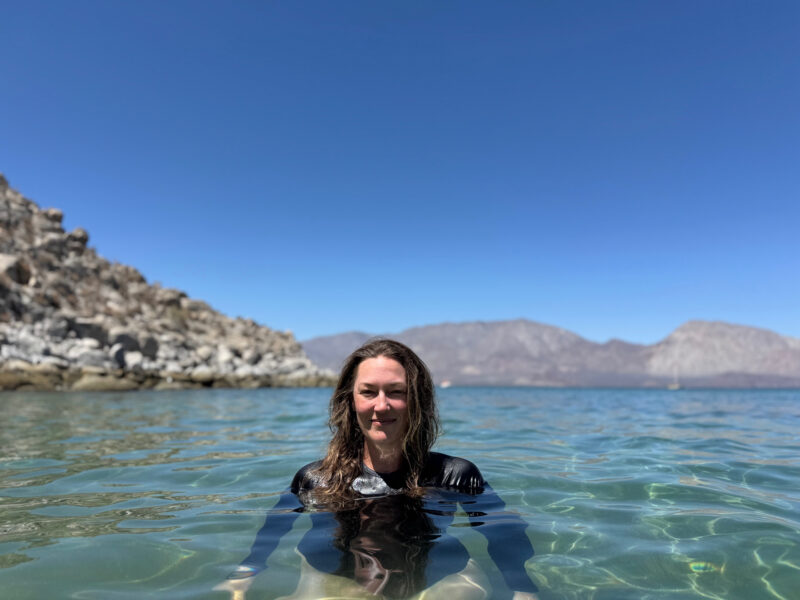
One of BWBS’ key team members is Dr. Lindsey Peavey Reeves, Senior Scientist and Manager of the Office of National Marine Sanctuaries (ONMS) Sound Monitoring Program, who works with NOAA and partners to maintain a nationally coordinated network of long-term passive acoustic monitoring sites across the National Marine Sanctuary System. This includes an established network along the West Coast called the Ocean Sound Observation Network.
Over more than a decade of monitoring, these efforts have developed the capacity to collect and process large volumes of acoustic data, integrate with other relevant data streams, and widely disseminate data summaries and condition indicators for marine managers, policymakers, and other end users. BWBS asked her to share a bit more to better understand how this work came to be, and its implications for marine protection.
How did you get started in bioacoustics?
I’d been researching migratory megafauna (sea turtles, whales, seabirds, fish) in the eastern tropical Pacific Ocean for several years before heading to graduate school. While at Duke’s Nicholas School of the Environment, I joined a multi-year humpback whale study in Antarctica.
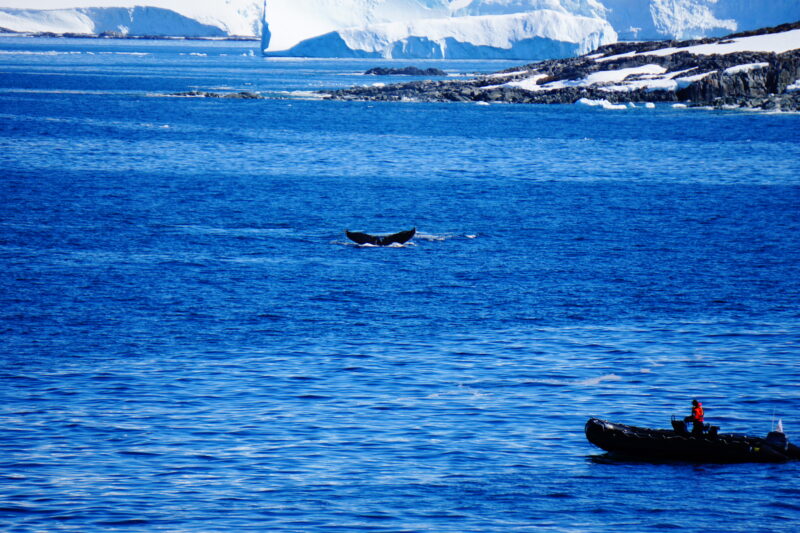
The team was mapping krill—humpback food—in secluded bays where humpbacks migrate to gorge during their foraging season. We were also suction-cup tagging individual whales to 4-D map their diving behavior in relation to krill swarms. Those tags also recorded sound, so we had beautifully clear 24-48 hour records of any vocalizations made by the tagged whale and surrounding animals. Dr. Alison Stimpert, who led the study’s bioacoustics component needed help, and I was eager to spend many, many hours manually scanning each tag record to identify repeated units and phrases that make up humpback whale song structure. It was fascinating to hear song in chilly Southern Ocean foraging grounds, since singing is directly linked to male breeding behavior in their tropical breeding grounds. We wrote a paper on our findings and that project was a springboard for my future career in underwater acoustics.
Now, we use machine learning analysis techniques to process lots of data for humpback whale song very quickly, but I wouldn’t trade the many hours I spent slowly working through the Antarctic tag recordings that provided me invaluable training.
Now, I study entire soundscapes, instead of just one whale species.
It’s incredible how many marine organisms rely on sound to thrive. (Almost all of them!)
We can observe entire breeding cycles of fish without laying eyes on the animals. We can measure a coral reef recovering after going quiet during a hurricane, or how much vessel noise is reduced when ships voluntarily slow down in important habitats. It’s an amazingly powerful, cost-effective, and non-invasive way to monitor marine ecosystems around the clock, without needing humans physically present.
Long-term underwater sound monitoring leaves a sound recorder in a fixed location for months at a time to passively observe in deep or shallow water, providing summary and single-source signals simultaneously. It can capture externalities like economic depressions or global pandemics, and can integrate with environmental parameters and other data streams like animal tracking and wind speeds to distill complex, layered information into easy-to-digest, management-relevant indicators.
What was the impetus behind the soundscape reporting website: SoundscapeMonitoring.us?
Many partners are collaborating to maintain over 40 underwater listening stations in and around 12 U.S. marine sanctuaries. Being able to summarize the massive amount of underwater sound data that’s continuously collected is critical formonitoring and better understanding these special ecosystems.
To synthesize all of this information into standard indicators that can be tracked over time and measure change from baseline conditions, we developed SoundscapeMonitoring.us. One of the critical outcomes of this body of work is the capacity to better understand the drivers of change, which could include changing environmental conditions, anthropogenic factors, and/or a management action. Soundscapes are inherently holistic and rooted in a place, and therefore SoundscapeMonitoring.us is organized by geographic places of interest like a marine protected area, New England, and the Humboldt Coast, for example.
Can you explain how this soundscape data is aggregated, and how it can be used and by whom?
Any data provider that archives their data at NOAA’s open access repository can present summary information for their monitoring location on the website. The ways in which we are interpreting the information to translate huge amounts of data into bite-sized, actionable information are making soundscape monitoring tangible for a wide variety of audiences, from fisheries managers to tribal groups to industry to whale enthusiasts. There is something for everyone on the website. We update it twice a year with the latest data from each monitoring location, and with new ways to track the status and trends of ocean indicators like baleen whale acoustic presence, vessel noise, and fish diversity. With our latest update in Oct 2026, we made the big-picture sound level figures interactive so that users can zoom into frequencies of interest to examine snapping shrimp signals, or time periods when vessel noise and baleen whales are overlapping most.
How does this ocean sound monitoring platform relate to BWBS?
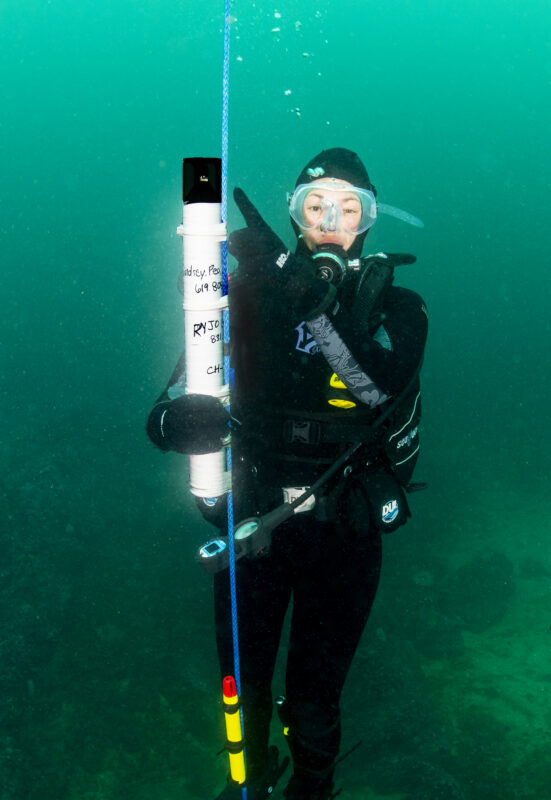
All of these listening stations were strategically selected to capture sound sources of interest. A few of the listening stations along the west coast are the hydrophones we work with Dr. Vanessa ZoBell at Scripps Institution of Oceanography to measure the reduction of underwater radiated noise during the active BWBS vessel speed reduction (VSR) program season. Having quantitative measurements of the conservation benefit participating BWBS vessels are providing when in VSR zones is imperative to communicate the value of the program and all of the collective effort these vessels are having when they cooperate with requested whale safe speeds of 10 knots or less. We are excited to provide the same measurements in the Pacific Northwest as vessel speed reduction continues to gain traction in other regions.
What’s some of the most important action items or resources that have come from launching the website, or that you hope will come out of it?
Our standardized, open-access approach to providing reliable and comparable data products across a large, coordinated network of listening stations is setting the bar for passive acoustic monitoring worldwide. The exciting thing about how we have collaboratively built the monitoring and reporting framework is that it is easily scalable. Any open-access acoustic data can be displayed on this website, or any soundscape monitoring program around the world can leverage the open workflow we have created to tailor-make a similar reporting platform for their unique needs. We hope that our innovations in resource sharing and standardized reporting demonstrate that the sky is the limit for long-term passive acoustic monitoring, with big contributions to marine conservation, like supporting global vessel speed reduction efforts.