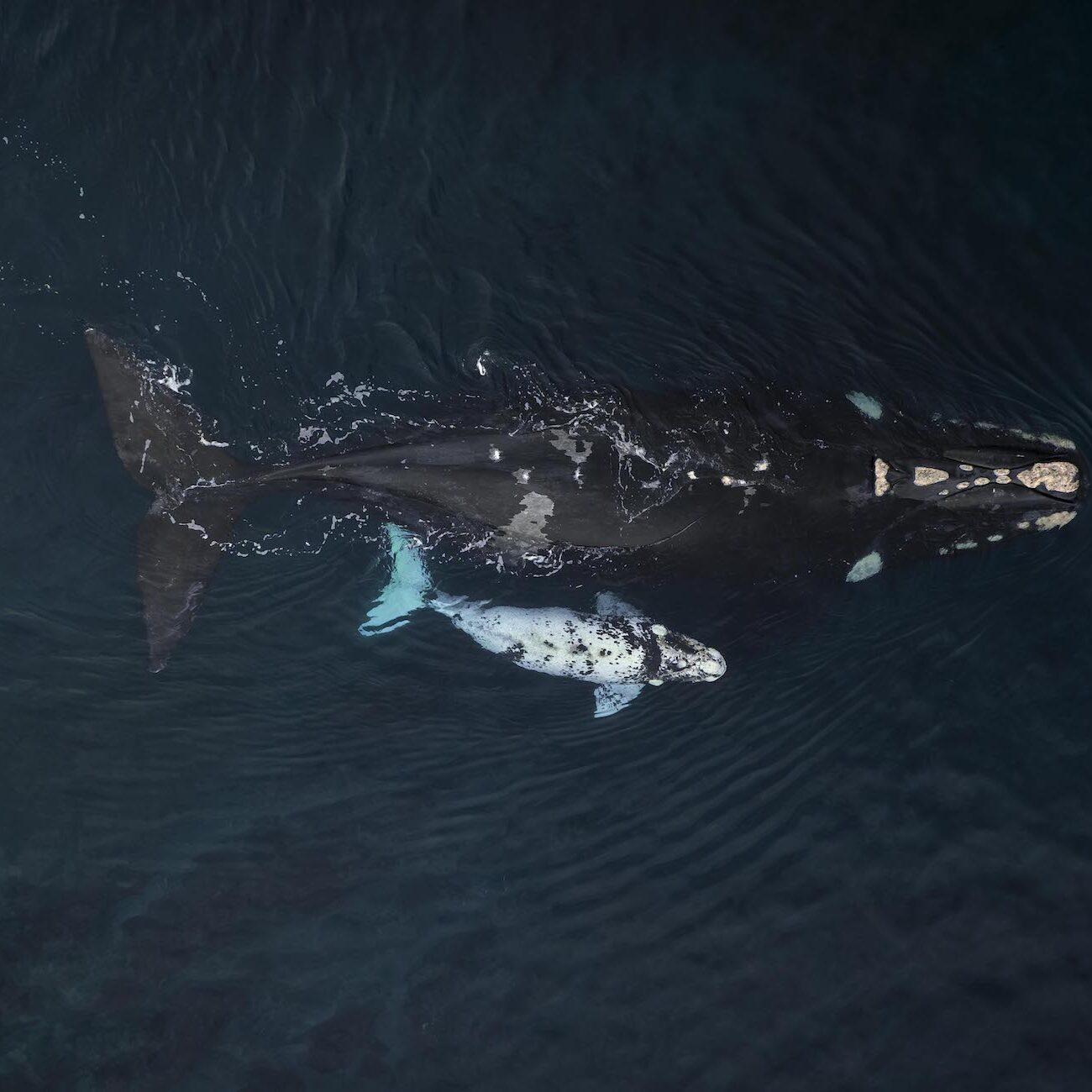
What we gain when we protect whales: restoring thriving whale populations is an act of building a resilient future
Share
Authors: Sara Hutto, Jessica Morten, Becca Tucker, & Kelly Tseng
For this inspiring story we address how whales are not only charismatic and inspiring creatures, but incredibly important to the health of our oceans, air, and ourselves.
Within the California Marine Sanctuary Foundation team, we talk a lot about how whale populations are still recovering from the industrial whaling era (a staggering 3 million whales were estimated to be killed over the course of the 20th century, resulting in devastating declines in whale populations and an 81% reduction in great whale biomass). Now, they face compounding and often interrelated threats: ship strikes, entanglement, habitat degradation, and climate change. It’s important to remember this historical context, especially when shifting baselines can distort perceptions of what wildlife abundance and healthy oceans should look like.
Most people – especially those who have been lucky enough to see them – agree that whales have intrinsic value. And that efforts to tackle the threats they face are warranted because other species on this planet should have the right to exist and thrive, regardless of what they offer us.
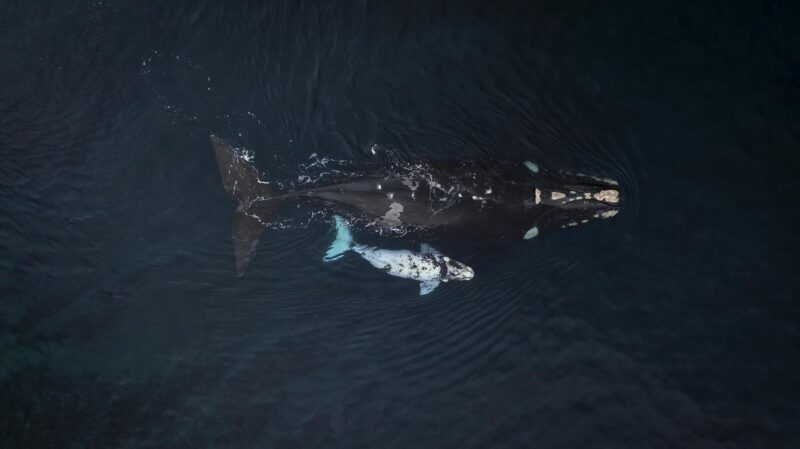
Adam Ernster
However, in the case of whales, their contributions are massive and there is much that we would lose if we don’t protect them, including:
- Whales are nature’s ocean fertilizers. Whales are not only some of the largest species to grace our planet – they also have some of the longest migrations on Earth. Along the way, whales fertilize (via their poop) the ecosystems they move through, providing critical nutrients that support other marine life. As whales migrate between nutrient-rich feeding grounds and nutrient-poor breeding grounds, they spread nutrients across ecosystems and ocean basins (the whale conveyor belt). Whales move nutrients horizontally across ocean surface waters via urine, sloughed skin, and placental material, and also vertically through the water column (often called the “whale pump”). This happens since whales often feed at depth, surfacing both to breathe and release nutrient-rich waste, carrying deep-ocean nutrients up to the surface, where the nutrients fertilize and support phytoplankton growth.
- Whales help create the air we breathe. Roughly half the Earth’s oxygen production is credited to the ocean, and specifically, from phytoplankton in the ocean. The nutrients whales mobilize and deliver to these phytoplankton is essential to the formation of their “blooms” known to be critical to the planet, forming the base of the marine food web. Further, whales may stimulate carbon fixation by phytoplankton – a major driver of carbon capture through photosynthesis.
- Whales lock away carbon in the deep sea. As some of the largest and longest-living animals on Earth, whales store large amounts of carbon in their bodies for decades. Moreover, whales typically lock that carbon in the deep sea: when whales die, their bodies most often do not wash ashore, but instead sink to the deep sea floor, storing away carbon for centuries. In the Eastern North Pacific alone, natural whale mortality is estimated to move nearly 3,000 megagrams of carbon to the deep sea every year (equivalent to removing over 2,300 vehicles from the road for a year).
- Whales give back to the deep sea after death. In addition to locking away carbon, when a whale dies and its body sinks to the deep sea floor (otherwise known as a “whale fall”), their carcass becomes habitat for deep sea scavengers including certain shark species, crustaceans, mollusks, worms, and specialized bacteria, cycling nutrients through the deep-sea ecosystem. The impacts of their presence are long-lasting too; their bones and the enriched sediment around a dead whale have been shown to support deep-water communities for decades.
For centuries, many humans viewed whales through the lens of what we could take from them. Today, the science is clear: what they contribute to us and this planet is irreplaceable. Whales are climate champions, deep-sea habitat architects, and the drivers of a global nutrient cycle that keeps our atmosphere balanced. What we stand to lose if we fail to protect them – and the habitat they depend on – isn’t just a species; it is the health of our oceans and, by extension, ourselves.
But to gain them back, and restore the thriving whale populations of the past, is an act of building a resilient future. Every whale we protect from a fatal vessel strike is an investment in a healthy planet.
After all, the air we breathe tomorrow may depend on a migrating whale today.
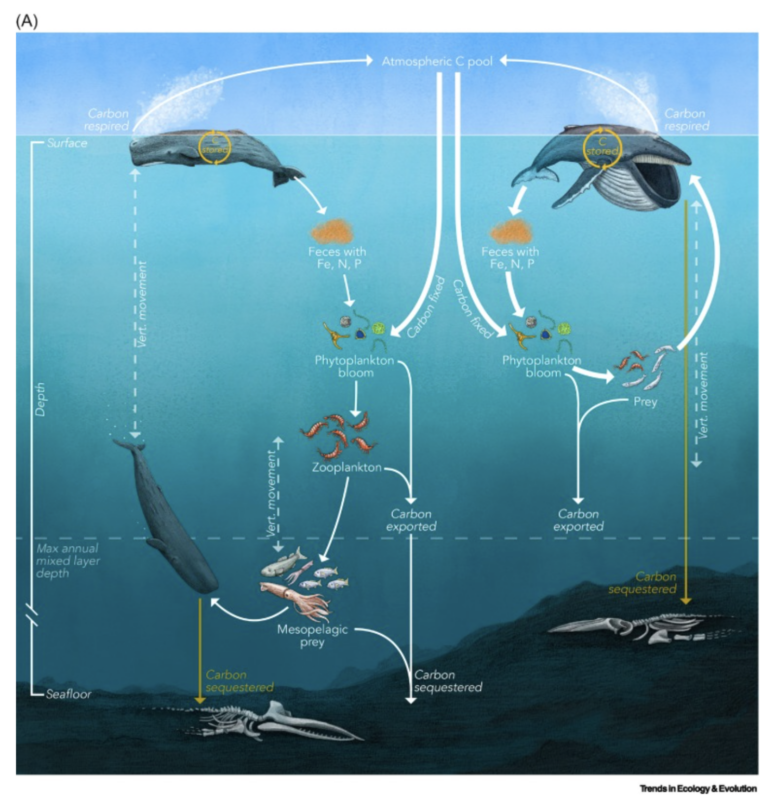
Pearson et. al., Trends in Ecology & Evolution, Volume 38, Issue 3, March 2023, Pages 238-249
Sources:
Pearson et al., Trends in Ecology & Evolution — Volume 38, Issue 3, March 2023, Pages 238-249, Whales in the carbon cycle: can recovery remove carbon dioxide?
NOAA Fisheries, 2024 — Whales and Carbon Sequestration: Can Whales Store Carbon?
Roman, J. & McCarthy, J.J., 2010, PLOS ONE — The Whale Pump: Marine Mammals Enhance Primary Productivity in a Coastal Basin
Roman, J., Abraham, A.J., Kiszka, J.J., et al., 2025, Nature Communications — Migrating Baleen Whales Transport High-Latitude Nutrients to Tropical and Subtropical Ecosystems
Pershing, A.J., et al., 2010, PLOS ONE — The Impact of Whaling on the Ocean Carbon Cycle: Why Bigger Was Better
Rui, C., Zhang, Y., et al., 2022, Frontiers in Ecology and Evolution — Review of the Impact of Whale Fall on Biodiversity in Deep-Sea Ecosystems
Pimm SL, Jenkins CN, Abell R, Brooks TM, Gittleman JL, Joppa LN, Raven PH, Roberts CM, Sexton JO. Science. 2014 May 30, The biodiversity of species and their rates of extinction, distribution, and protection.